

Loft Insulation Glenrothes
Glenrothes was built for a coal mine that never worked, then rebuilt around electronics. The decade your street went up tells you more about your loft than the house type does.
- Free, no-obligation survey
- Written quote, no hard sell
- Glenrothes, Leslie and Markinch
Get your Glenrothes loft survey
Free · No obligation · Written quote
Your details are used only to arrange your survey. See our privacy policy.
A town built twice
Glenrothes was designated in 1948 to house miners for the Rothes Colliery. The pit flooded, closed in 1961, and the town was left with housing built for an industry that never arrived. It was then rebuilt around electronics, and grew again through the 1960s and 1970s.
That history is still in the streets, and it is the most useful thing to know before insulating a loft here. The decade a house went up tells you more about what is above the ceiling than the style of the house does.
The first wave, roughly 1950 to 1960
Woodside, Auchmuty and the earliest parts of the town. An energy efficient home was not a design consideration in 1952. Built quickly, to the standards of the day, which meant little or no insulation at all when new. Most have had something added since, often under a council programme, but rarely to anything like the depth now recommended. These lofts usually hold a thin, settled layer sitting level with the joists. Topping them up to full depth is among the cheapest ways to improve energy efficiency in the town, and it significantly reduces what the house costs to heat.
The second wave, roughly 1960 to 1980
Macedonia, Caskieberran, Pitteuchar, Cadham and Collydean. Bigger, and built when insulation had started to be taken seriously, though the standard of the time was still far below 270mm. Some of this stock is non-traditional construction, and a proportion has shallow roof pitches or unusual truss arrangements that make the eaves tight to work in. It is entirely insulatable, but it is worth someone looking before a price is given, because thermal performance depends on how well the material reaches the eaves rather than on how much goes in.
The older villages
Leslie, Markinch, Thornton and Kinglassie predate the new town by centuries. Stone properties, more varied roof spaces, and a much higher chance the loft has never been touched. These are the biggest single improvements available around Glenrothes, and the energy savings are correspondingly larger.
How we insulate a loft, and to what depth
Loft insulation slows heat escaping through the roof and keeps it in the living space below. Around a quarter of the heat loss from an uninsulated house goes upwards, which is why insulating your loft is the primary insulation measure for most homes and the one that pays back fastest. Proper insulation means lower energy bills, steadier indoor temperatures and a better energy performance certificate, and unlike most home improvements the cost of insulation work is recovered within a few years of reduced heating bills.
The recommended depth in Scotland is 270mm of mineral wool. That is guidance for an existing home, not a legal requirement, and 270mm is not a legal minimum that anyone can enforce on you. Because ceiling joists in older Ayr properties are often only 100mm deep, reaching that depth means one layer between the joists and a second laid across them.
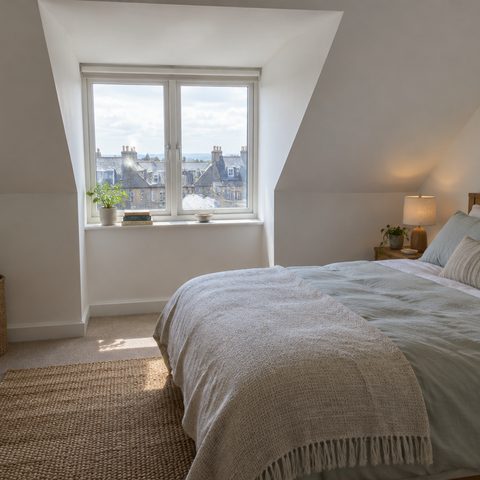
Where the space is a room in the roof rather than an open loft, depth is not the measure that matters. The sloped sections have a fixed cavity between the plasterboard and the sarking, so the job becomes about achieving a sensible U-value within the space available while leaving a ventilation gap above the insulation. That is a different specification, and a different price.
Choosing a type of insulation is less complicated than the marketing suggests. The real question is whether the insulation materials need to be natural or synthetic, and how much depth the loft space allows. There is no single best insulation type for every house, and the insulation solutions that suit a coastal bungalow are not the ones that suit a room in the roof, which is why we look first and recommend second.
- Mineral wool insulation: the standard specification, and the best value insulation product for most lofts.
- Sheep wool and hemp: sustainable insulation in natural fibre that handles moisture well, which counts for a lot on a wet, exposed coast.
- Multifoil: a slim reflective quilt where depth is restricted or at rafter level.
- Rigid PIR insulation boards: the usual choice for room in roof insulation, at the slope and the dwarf walls.
We do not install spray foam insulation. Applied to the roof slope it traps moisture against the timbers, prevents inspection, and has caused serious problems for homeowners selling or remortgaging.
It is worth being clear about scope. Loft and roof insulation is all we do. We do not offer cavity wall insulation, external wall insulation, internal wall insulation or underfloor insulation, and we are not a general home insulation contractor. If your house needs one of those measures, you want a firm that fits them every week rather than one adding it on. Plenty of insulation companies in Ayrshire cover the full range, and there is no shortage of choice.
Should old loft insulation be removed?
Usually not. Dry, clean, evenly laid insulation can be topped up, which is cheaper and works just as well. Removal is justified where material has been soaked through a leak, contaminated, or degraded to the point of doing nothing. It is worth being direct about this: removal is the most commonly upsold item in loft work, and it adds several hundred pounds. Ask why it is being proposed, and expect a specific answer about your loft rather than a general one. Our guide to removing old loft insulation goes into it properly.
Is loft insulation a DIY project?
An open bungalow loft, yes. If the space is accessible and safe to move around in, laying wool is not difficult and the materials are inexpensive. What a professional insulation specialist brings is expertise rather than muscle: spotting blocked eaves, cables buried under the existing layer, downlights that must not be covered, or damp that needs dealing with before anything goes on top.
A room in the roof is not a DIY job. It involves opening up finished surfaces, and getting the ventilation wrong in a sloped ceiling causes condensation inside the structure where you cannot see it.
Can I still use the loft for storage?
Yes, with a raised loft storage system that holds the deck above the full insulation depth. Loft boarding screwed straight to the joists crushes the layer beneath and wastes most of what you paid for, which is the most common way good insulation is made ineffective. In a bungalow, where the loft space is usually the only spare storage in the house, this is worth getting right rather than discovering later.
How long does it last?
Mineral wool does not wear out, but it settles and compresses, particularly where people have walked on it. A layer laid in the 1980s is usually performing well below its original figure. That is why we measure rather than take the previous installer's word for it.
If there is a tank up there. Insulating the ceiling makes the roof space above it colder, so a cold water tank or any exposed pipework needs protecting at the same time. Our guide to water tanks and pipes explains why you never insulate underneath a tank.
What we are actually looking at
Most lofts fall into one of these. The survey is about working out which, and what it needs.


What we install, and how deep
Loft insulation prevents heat from escaping through the roof. Around a quarter of the heat that escapes from an uninsulated house goes that way, so insulating your loft reduces heat loss more cheaply than any other measure and repays itself fastest in lower heating costs. It slows heat transfer in both directions, which is why the work keeps a home warmer in winter and steadier in summer.
Effective insulation is mostly about depth and detailing. The recommended depth in Scotland is 270mm of mineral wool at ceiling level. It is guidance under current building regulations for an existing home rather than a legal requirement. Because joists here are commonly 100mm deep, reaching it means one layer between the joists and a second laid across them.
- Mineral wool insulation, including Knauf blanket insulation, is the standard specification and the best value for most lofts.
- Sheep's wool and hemp: natural materials that handle moisture well.
- Multifoil: a slim reflective quilt where the depth available is restricted, which is useful in the shallower new town roofs.
- PIR insulation boards: rigid board for room in roof insulation in a converted loft.
We do not install spray foam insulation. Sprayed onto the roof timbers it traps moisture, prevents inspection and has caused real problems for people selling or remortgaging.
Loft and roof insulation is all we do. We do not offer cavity wall insulation, solid wall insulation, external wall insulation or underfloor insulation, and we do not sell insulation supplies. If a wall or a floor is your real problem, you want a firm that fits those every week. For loft insulation in Glenrothes, a local loft specialist is the better bet.
Should old insulation be removed first?
Usually not. Dry, clean existing material can be topped up, which is cheaper and performs just as well. Removal is warranted where it is wet, contaminated or completely degraded. Our guide to removing old loft insulation covers when it is genuinely needed.
Will insulating cause condensation?
Only if the ventilation is ignored. A colder roof space holds less moisture before it condenses, so the eaves have to stay clear. Our condensation guide explains it properly.
Loft insulation grants in Fife
We do not carry out grant-funded installations. We are not registered under any of the schemes below, so our work is paid for privately. This is here because free insulation is genuinely available to some households and worth checking before you pay anyone, ourselves included.
Fife has its own energy advice service, Cosy Kingdom, run with Fife Council and Citizens Advice. It is the sensible first call for anyone in Glenrothes, because it checks every national scheme and the local ones in a single conversation.
- ECO4: funded by energy suppliers for households on qualifying benefits with an energy rating of D to G. Extended to 31 December 2026.
- Great British Insulation Scheme: closed to new applications on 31 March 2026. Any page still offering it is out of date.
- Warmer Homes Scotland: for households in or at risk of fuel poverty.
Home Energy Scotland also checks every route free on 0808 808 2282. These positions were checked in September 2026 and scheme rules change.
Choosing insulation installers in Glenrothes
Professional installation earns its money on the detailing rather than the laying. Five things worth asking anyone quoting in Glenrothes, ourselves included:
- Find out which decade your house belongs to. A 1950s loft and a 1970s loft need different things, and an installer who has not asked has not looked.
- Get the existing depth in millimetres, measured rather than estimated from the hatch.
- On the shallower new town roofs, ask specifically how they will reach the eaves without packing them solid.
- Speak to Cosy Kingdom before you commit. If funding covers you, it costs you nothing to find out.
- Get the price and guarantee in writing before any deposit changes hands.
We work across Fife most weeks, covering Kirkcaldy and Dunfermline as well as Glenrothes. Every job starts with someone going up through the hatch and coming back down with a number. That number, not the house type, is what the written quote is built on. Fully insured, trading since 2016, and the peace of mind people are really paying for is that the team that quoted is the team that turns up.
Areas we cover around Glenrothes
- Glenrothes
- Woodside
- Auchmuty
- Macedonia
- Caskieberran
- Pitteuchar
- Cadham
- Collydean
- Leslie
- Markinch
- Thornton
- Kinglassie
- Star
- Coaltown of Balgonie
The work, filmed as it happens
Short clips from real jobs. Nothing staged, and nothing loads until you press play.
Frequently asked questions
It depends on the loft area, the existing depth and the access rather than the postcode. A top-up in a new town semi is at the cheaper end, and a bare loft in an older village property costs more. The survey turns that into a fixed written price.
Possibly. Cosy Kingdom is the Fife-wide energy advice service and the sensible first call, because it checks the national and local routes together. ECO4 can fully fund insulation for households on qualifying benefits with an EPC of D to G. We do not carry out grant-funded work ourselves.
Look at the joists. If you can see the tops of the timbers, you are at roughly 100mm and there is a worthwhile improvement available. At 270mm the joists disappear completely under the second layer.
It is not harmful, but it will not help prevent heat escaping much more than 270mm already does, and the returns fall away sharply beyond that depth. Going deeper costs more, takes more headroom and saves very little extra. We would rather see 270mm laid properly with the eaves clear than 400mm crammed in.
Usually not, provided it is dry and clean. Topping up is cheaper and performs just as well. Removal is warranted where the material is wet, contaminated or has degraded completely.
Yes. We work across central Fife including Leslie, Markinch, Thornton, Kinglassie and the villages around Glenrothes, as well as Kirkcaldy, Leven and Dunfermline.
Book a free Glenrothes loft survey
We go into the roof space, tell you what it needs and put a written quote in your hands. No pressure and no obligation.