

EasyQuilt vs Mineral Wool
A slim reflective quilt against the industry default. Where the multifoil justifies the price, and where it does not.
At a glance
| EasyQuilt (multifoil) | Mineral wool | |
|---|---|---|
| Material | Reflective foil layers with wadding | Glass wool or rock wool fibre |
| Thickness | Around 40mm plus air gaps | 270mm recommended in a cold loft |
| Mechanism | Reflects radiant heat | Traps still air to slow conduction |
| Fire performance | Check the product certificate | Non-combustible (rock wool especially) |
| Acoustic performance | Limited | Good, improves with depth |
| Vapour control | Yes, when taped and sealed | No |
| Grant schemes | Less commonly specified | The default specification |
| Cost per m² | High | Low |
| Installation risk | High: depends on air gaps and sealing | Low: depends mainly on depth and eaves |
Two different kinds of insulation
Mineral wool is the umbrella term for glass wool and rock wool. Both trap still air inside a fibre mat, and both get better roughly in proportion to how thick you lay them. It is the most widely used loft insulation material in the UK for the straightforward reason that it delivers more thermal resistance per pound than anything else when you have the depth to spare.
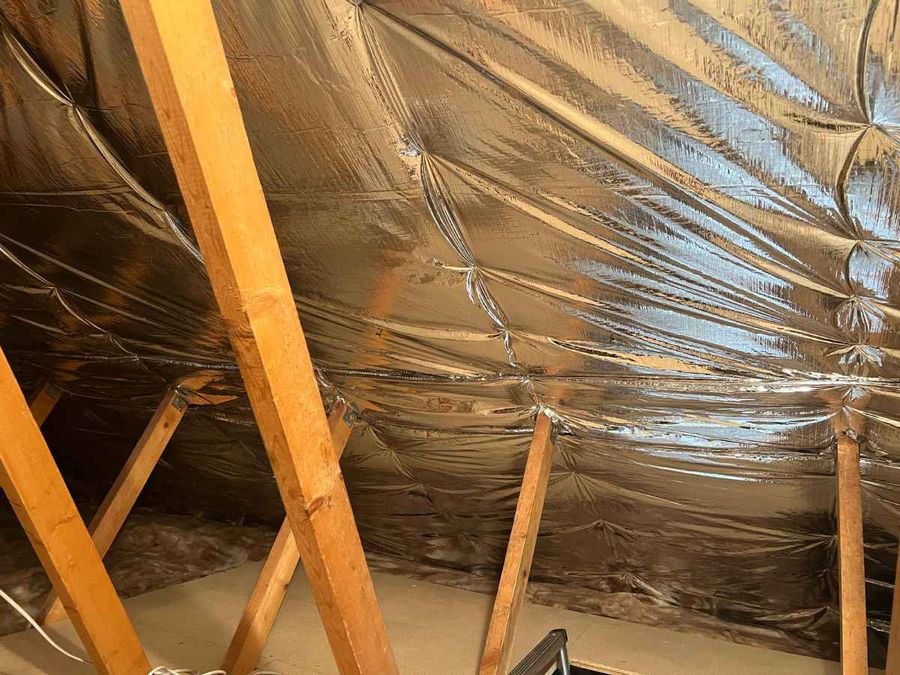
EasyQuilt is a multifoil insulation: layers of metallised foil and wadding built into a quilt around 40mm thick. It works primarily by reflecting radiant heat, which means it needs an air gap on both faces to function as certified. Compress it against a rafter and the reflective mechanism has nowhere to work.
Thermal performance
270mm of mineral wool gives a thermal resistance somewhere around 6.7 m²K/W. Multifoil certified for roof use delivers a fraction of that figure on its own within its tested build-up. That is why multifoil is normally specified as part of a layered system to reach a target U-value, and why it is not a like-for-like swap for a full depth of wool.
A note on performance figures. Multifoil products are tested and certified as part of a build-up, not on their own, and the certified thermal resistance depends on the air gaps either side and whether it is a roof, wall or floor application. Always quote the figures from the current BBA certificate for the exact product and application, and never a general “equivalent to X mm of wool” claim. Comparative performance claims for insulation have attracted regulatory attention before, so keep them specific and evidenced.
The practical way to think about it: wool buys you thermal resistance cheaply if you have the room. Multifoil buys you thermal resistance expensively in very little room. Whether that trade is worth making depends entirely on whether the room exists.
Three things mineral wool does that multifoil does not
- Fire. Mineral wool, and rock wool in particular, is non-combustible. In a roof space that is a meaningful property, and it is one reason wool remains the default in specification.
- Sound. A deep wool layer noticeably damps noise between the loft and the rooms below. A 40mm foil quilt does very little acoustically.
- Scheme acceptance. Government-backed funding schemes are built around conventional insulation measures. If you are pursuing grant funding, mineral wool is the path of least resistance.
Three things multifoil does that wool does not
- Fit in tight spaces. In a shallow post-war roof or a conversion, 270mm simply is not available. 40mm is.
- Control vapour. Taped and sealed on the warm side, EasyQuilt functions as a vapour control layer. Wool has no vapour resistance at all and needs a separate membrane where one is required.
- Stay uncompressed. Wool loses performance the moment someone kneels on it or boards over it. A foil quilt fixed to rafters holds its geometry.
What each one is like to live with
Mineral wool is itchy, dusty work and needs a mask, gloves and long sleeves. It also settles: a 100mm layer laid in the 1990s is frequently performing like 70mm today. Multifoil is clean to handle and cuts with a knife, but it is far less forgiving of a rushed installation. Missed air gaps and untaped laps quietly destroy its performance in a way that is invisible once the plasterboard goes up.
That asymmetry matters when choosing. A mediocre wool installation still works reasonably. A mediocre multifoil installation may not.
Which should you choose?
Open cold loft, decent headroom, no conversion planned: mineral wool to 270mm. It is cheaper, more forgiving, non-combustible and better acoustically. This covers the majority of Scottish homes and it is what we recommend most often.
Loft conversion or room in roof: a layered build-up, typically rigid board between the rafters with EasyQuilt providing the slim additional layer and vapour control.
Shallow roof where 270mm will not fit at the eaves: wool across the main area, tapered at the eaves, with multifoil considered where the pinch is severe.
The honest summary is that mineral wool is the default and multifoil is the specialist. Anyone selling you the specialist for a job the default handles better is selling, not advising.
Frequently asked questions
Not on its own in a typical cold loft. Certified thermal resistance for multifoil in a roof application is a fraction of what 270mm of mineral wool delivers, which is why it is normally used as part of a layered build-up to reach a target U-value. Ask for the BBA certificate figures for the specific product and application rather than accepting a general equivalence claim.
For a standard open cold loft, yes: it is cheaper for the same thermal resistance, non-combustible, better acoustically and more forgiving to install. Multifoil becomes the better answer where depth is genuinely restricted, such as a conversion or a shallow post-war roof.
Yes. Multifoil works largely by reflecting radiant heat, and reflection needs space to work into. The certified performance assumes an air gap on both faces, so fitting it tight against a surface loses much of the benefit you paid for. The required gaps are specified in the installation guidance.
Mineral wool, comfortably. A deep fibre layer absorbs sound energy in a way a thin reflective quilt does not. If reducing noise transfer between the loft and the rooms below matters to you, depth of wool is what does it.