

Loft Insulation Ayr
Loft insulation in Ayr is rarely the simple job it is sold as. A great many homes here and along the coast do not have a simple open loft at all. Rooms in the roof, coombed ceilings and cramped crawl spaces need a different approach, so we survey before quoting.
- Free, no-obligation survey
- Written quote, no hard sell
- Ayr, Prestwick, Troon and Carrick
Get your Ayr loft survey
Free · No obligation · Written quote
Your details are used only to arrange your survey. See our privacy policy.
Why so many Ayr lofts are not really lofts
The assumption behind most loft insulation quoting is that there is an open, empty space above the ceiling with joists you can roll wool between. Across a large part of Ayr, Prestwick and Troon, that assumption is wrong, and it is the single biggest reason quotes given over the phone turn out to be worthless here.
One and a half storey houses and coombed ceilings
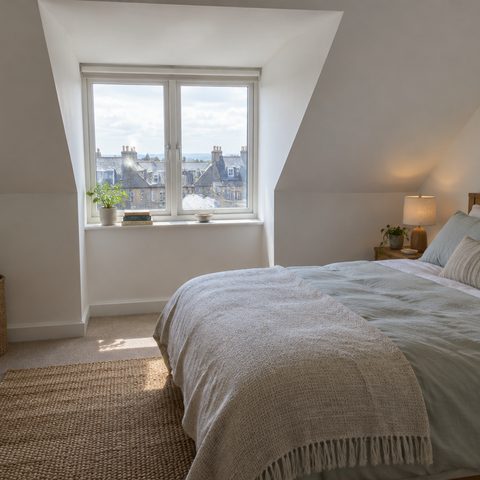
South Ayrshire has an unusually high proportion of one and a half storey houses, where the upper floor sits inside the roof itself. The ceilings slope, the walls meet the slope at a low level, and what is left above is a shallow crawl space rather than a loft. Insulating one of these properly means treating three different surfaces: the flat ceiling at the top, the sloped section, and the small vertical stud walls at the eaves, usually called dwarf walls.
Rolling wool across whatever part of the flat area you can reach leaves the sloped sections doing nothing, and the sloped sections are where most of the heat is going. This is room in roof insulation rather than a straightforward loft job, and it should be priced and explained as such.
The seaside bungalows of Prestwick and Troon
The interwar and post-war expansion along the coast produced a great many bungalows, and they carry a particular problem: the ratio of roof to floor area is far higher than in a two storey house, so a bungalow loses proportionally more heat upwards. Many of these roofs also have restricted headroom at the eaves.
The good news is that these are usually open lofts with sound access, so they are the fastest and cheapest jobs we do in the area. The base layer is often there already from an earlier programme and simply needs topping up to current depth.
Victorian and Edwardian stone in the town
The older stone properties through central Ayr and along the front are typically slate on sarking boards with no breathable membrane underneath. Roofs like that stay dry through air movement, not through a barrier, so blocking the eaves to squeeze in more depth causes more problems than the extra insulation solves.
The Carrick villages
South of the town, Maybole, Girvan, Dailly and the smaller Carrick settlements sit further from the gas network, and a good number of these homes heat with oil, LPG or electricity. Where the fuel costs more per unit of heat, the same loft job pays for itself faster. The building types are much the same as Ayr, so it is the economics that differ rather than the work.
A wet climate, not just a cold one. The west coast is milder than most of Scotland but considerably wetter and windier, and moisture is the constraint that governs loft work here far more than temperature. Insulation increases the temperature difference across the roof space, which means any moisture already finding its way up there is more likely to condense. That is why ventilation gets checked before depth does.
How we insulate a loft, and to what depth
Loft insulation slows heat escaping through the roof and keeps it in the living space below. Around a quarter of the heat loss from an uninsulated house goes upwards, which is why insulating your loft is the primary insulation measure for most homes and the one that pays back fastest. Proper insulation means lower energy bills, steadier indoor temperatures and a better energy performance certificate, and unlike most home improvements the cost of insulation work is recovered within a few years of reduced heating bills.
The recommended depth in Scotland is 270mm of mineral wool. That is guidance for an existing home, not a legal requirement, and 270mm is not a legal minimum that anyone can enforce on you. Because ceiling joists in older Ayr properties are often only 100mm deep, reaching that depth means one layer between the joists and a second laid across them.
Where the space is a room in the roof rather than an open loft, depth is not the measure that matters. The sloped sections have a fixed cavity between the plasterboard and the sarking, so the job becomes about achieving a sensible U-value within the space available while leaving a ventilation gap above the insulation. That is a different specification, and a different price.
Choosing a type of insulation is less complicated than the marketing suggests. The real question is whether the insulation materials need to be natural or synthetic, and how much depth the loft space allows. There is no single best insulation type for every house, and the insulation solutions that suit a coastal bungalow are not the ones that suit a room in the roof, which is why we look first and recommend second.
- Mineral wool insulation: the standard specification, and the best value insulation product for most lofts.
- Sheep wool and hemp: sustainable insulation in natural fibre that handles moisture well, which counts for a lot on a wet, exposed coast.
- Multifoil: a slim reflective quilt where depth is restricted or at rafter level.
- Rigid PIR insulation boards: the usual choice for room in roof insulation, at the slope and the dwarf walls.
We do not install spray foam insulation. Applied to the roof slope it traps moisture against the timbers, prevents inspection, and has caused serious problems for homeowners selling or remortgaging.
It is worth being clear about scope. Loft and roof insulation is all we do. We do not offer cavity wall insulation, external wall insulation, internal wall insulation or underfloor insulation, and we are not a general home insulation contractor. If your house needs one of those measures, you want a firm that fits them every week rather than one adding it on. Plenty of insulation companies in Ayrshire cover the full range, and there is no shortage of choice.
Should old loft insulation be removed?
Usually not. Dry, clean, evenly laid insulation can be topped up, which is cheaper and works just as well. Removal is justified where material has been soaked through a leak, contaminated, or degraded to the point of doing nothing. It is worth being direct about this: removal is the most commonly upsold item in loft work, and it adds several hundred pounds. Ask why it is being proposed, and expect a specific answer about your loft rather than a general one. Our guide to removing old loft insulation goes into it properly.
Is loft insulation a DIY project?
An open bungalow loft, yes. If the space is accessible and safe to move around in, laying wool is not difficult and the materials are inexpensive. What a professional insulation specialist brings is expertise rather than muscle: spotting blocked eaves, cables buried under the existing layer, downlights that must not be covered, or damp that needs dealing with before anything goes on top.
A room in the roof is not a DIY job. It involves opening up finished surfaces, and getting the ventilation wrong in a sloped ceiling causes condensation inside the structure where you cannot see it.
Can I still use the loft for storage?
Yes, with a raised loft storage system that holds the deck above the full insulation depth. Loft boarding screwed straight to the joists crushes the layer beneath and wastes most of what you paid for, which is the most common way good insulation is made ineffective. In a bungalow, where the loft space is usually the only spare storage in the house, this is worth getting right rather than discovering later.
How long does it last?
Mineral wool does not wear out, but it settles and compresses, particularly where people have walked on it. A layer laid in the 1980s is usually performing well below its original figure. That is why we measure rather than take the previous installer's word for it.
If there is a tank up there. Insulating the ceiling makes the roof space above it colder, so a cold water tank or any exposed pipework needs protecting at the same time. Our guide to water tanks and pipes explains why you never insulate underneath a tank.
What we are actually looking at
Most lofts fall into one of these. The survey is about working out which, and what it needs.


Loft insulation cost in Ayr
The cost of insulation work tracks loft area, existing depth and access. Bungalow top-ups are at the cheaper end and room in roof work is a different order of job entirely. Every insulation job is priced from the survey, so these ranges are for budgeting, not a quote.
| Job | Typical property | Indicative cost |
|---|---|---|
| Top up to 270mm | Seaside bungalow | £400 – £700 |
| Top up to 270mm | Three-bedroom semi or terrace | £550 – £900 |
| Full install, bare loft | Victorian stone property | £750 – £1,400 |
| Room in roof insulation | One and a half storey house | £1,800 – £4,500 |
| Removal of existing insulation | Added to any of the above | £400 – £900 |
Replace these figures before publishing. Placeholder ranges based on typical UK pricing. Substitute your own South Ayrshire pricing or remove the table.
Loft insulation grants in Scotland
We do not carry out grant-funded installations. We are not currently registered under any of the schemes below, so all of our work is paid for privately. This section is here because the funding is real and worth knowing about, not because it is something we can arrange for you.
If a scheme would cover your loft, you are better off going to an accredited installer than to us. We would rather say that here than after a survey.
Government grants for insulation do exist in Scotland, and it is worth checking them before paying privately for anything. The Home Energy Scotland Grant and Loan covers up to 75% of the combined cost of energy efficiency measures such as insulation, to a maximum grant of £7,500, with an optional interest-free loan for the balance. It is not means-tested, though you must own and live in the property and hold a valid EPC listing the improvement.
- Great British Insulation Scheme: closed to new applications on 31 March 2026. Pages still offering it are out of date.
- ECO4: the Energy Company Obligation, delivered by energy suppliers to low-income and vulnerable households. Extended to 31 December 2026.
- Warmer Homes Scotland: for households in or at risk of fuel poverty.
- South Ayrshire Council: runs its own energy advice referrals alongside the national schemes.
Funding is not available for spray foam, and several schemes require a TrustMark registered installer. Home Energy Scotland checks every route free on 0808 808 2282.
Finding a reliable insulation company in Ayr
There is no shortage of people offering insulation in Ayr, and the standard of work varies more than the prices do. Effective insulation depends far more on how it is installed than on which product goes in, so the questions below matter more than the brand on the packaging. What we would tell anyone comparing quotes for insulation in Ayr, including quotes against ours:
- Ask whether anyone has physically been into the loft. A quote given from the driveway is a guess.
- Ask what depth they are quoting and how they will handle the eaves. If the eaves are not mentioned, the ventilation has not been considered.
- Ask whether removal is genuinely needed or assumed. It adds hundreds of pounds.
- If your upstairs is inside the roof, ask specifically how the sloped sections and the dwarf walls will be treated. A price that only covers the flat bit is not a price for the job.
- Ask for the price and the guarantee in writing before any deposit changes hands, and check what happens if they find damp or damage under the floor of the loft.
- Check customer reviews, and check the insulation installer is fully insured.
- Ask to see insulation installed locally, and whether they have done insulation for homes like yours. Any insulation specialists worth hiring will have recent work nearby they can point to.
We are based in Glasgow and work across Ayrshire regularly, from Ayr out to Prestwick, Troon and Maybole and south through Carrick. We survey first, explain what insulation for your home actually requires, and quote in writing. The job is handled by the same team from start to finish, done efficiently, with no mess left behind at completion. As a fully insured insulation company with a proven track record since 2016, that is the whole service. Our customer reviews are published under the Easy-Sprayaway name.
Areas we cover around Ayr
- Ayr
- Prestwick
- Troon
- Alloway
- Doonfoot
- Monkton
- Symington
- Tarbolton
- Mauchline
- Maybole
- Dundonald
- Coylton
- Dalrymple
- Girvan
Frequently asked questions
It depends on the size of the loft, what is already up there and how easy the access is. Top-up jobs on the coastal bungalows are at the cheaper end. A room in the roof, where the upstairs sits inside the roof space, is a larger piece of work and costs considerably more. The survey gives you a fixed written price rather than an estimate.
Yes, though it is a different job from a standard loft. There are three surfaces to deal with: the flat ceiling above, the sloped sections, and the dwarf walls where the slope meets the floor. It normally means rigid board at the slope with a ventilation gap kept above it. We would want to see it before saying what it involves, because the construction varies a lot between one house and the next.
Usually not. Dry, clean insulation can be topped up, which is cheaper and performs just as well. Removal is warranted where the material has been soaked, contaminated or has degraded completely. It is the most commonly upsold item in loft work, so ask for a specific reason.
270mm of mineral wool at ceiling level is the recommended depth. It is guidance for an existing home rather than a legal requirement, and because older joists are often only 100mm deep it usually takes two layers to achieve.
It affects how the work should be done. Ayrshire is milder than much of Scotland but wetter and windier, so ventilation matters more than depth alone. Insulating increases the temperature difference across the roof space, so any moisture reaching it is more likely to condense. Keeping the eaves clear is part of the job, not an optional extra.
Yes. We work across Prestwick, Troon, Alloway, Monkton, Symington, Maybole, Girvan and the smaller Carrick settlements as well as Ayr itself.
Book a free Ayr loft survey
We go into the roof space, tell you what it needs and put a written quote in your hands. No pressure and no obligation.