

SuperQuilt vs Fibreglass Insulation
Almost every comparison of these two is published by someone who sells one of them. Here is the version that says where each actually wins.
At a glance
| SuperQuilt (multifoil) | Fibreglass (glass wool) | |
|---|---|---|
| What it is | Layered reflective foil quilt, typically around 40mm thick | Spun glass fibre in rolls, laid to depth |
| How it works | Reflects radiant heat, plus some resistance from the wadding layers | Traps still air in the fibre to slow conduction and convection |
| Typical use | Rafter level, warm roofs, conversions, restricted depth | Cold loft floor, between and over the joists |
| Thermal resistance | Certified as part of a build-up with air gaps | Roughly proportional to depth; 270mm is the recommendation |
| Depth needed | Slim, around 40mm plus air gaps | 270mm for a cold loft |
| Cost per m² | High | Low |
| Handling | Clean, no itch, cuts with a knife | Itchy; needs mask, gloves, long sleeves |
| Vapour control | Acts as a vapour control layer when taped and sealed | None; needs a separate VCL where required |
| Fire | Check the certificate for the specific product | Non-combustible |
How each one actually works
This is where most of the confusion starts, because the two types of insulation resist heat transfer in completely different ways.
Fibreglass insulation, sold as glass wool and often spelled fiberglass by American suppliers, works by trapping still air inside a mat of fine fibres. Still air has low thermal conductivity, so heat struggles to pass through. Its thermal performance is roughly proportional to how thick the layer is, which is why depth is the whole conversation with wool and why 270mm is the number everyone quotes.
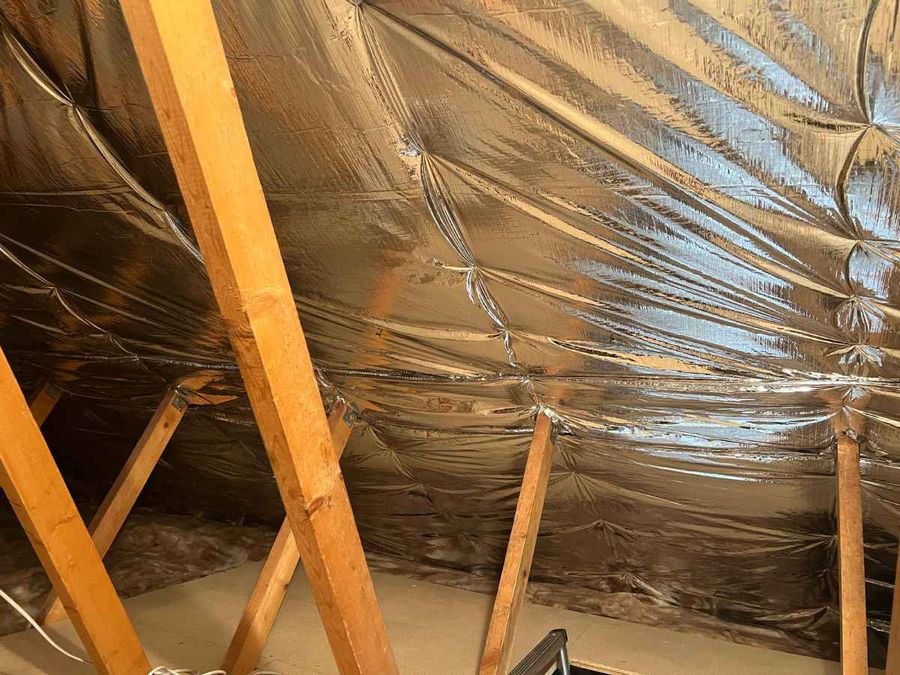
YBS SuperQuilt is a multifoil: multiple foil sheets and wadding sandwiched into a quilt about 40mm thick, forming a thermal barrier over the living space below. It works mainly by reflecting radiant heat back the way it came, with the wadding layers adding some conventional resistance. Because reflection needs somewhere to reflect into, multifoil insulation depends on an air gap on each side. Fit it tight against a surface and you lose much of what you paid for.
That difference explains the rest of this page. Insulation rolls of wool need depth. Multifoil needs air gaps and careful sealing. Both aim to reduce heat loss from an otherwise uninsulated loft; neither is the universally right type of insulation.
Thermal performance: the honest version
A properly detailed cold loft with 270mm of mineral wool or fibreglass achieves a thermal insulation value, expressed as thermal resistance, in the region of 6.7 m²K/W. Multifoil products certified for roof applications typically deliver a fraction of that on their own, which is precisely why they are normally specified alongside other insulation to reach a target U-value rather than instead of it.
This is the single most misrepresented point in the whole category. If you read that a 40mm quilt replaces 270mm of wool, treat it with scepticism and ask for the certificate.
A note on performance figures. Multifoil products are tested and certified as part of a build-up, not on their own, and the certified thermal resistance depends on the air gaps either side and whether it is a roof, wall or floor application. Always quote the figures from the current BBA certificate for the exact product and application, and never a general “equivalent to X mm of wool” claim. Comparative performance claims for insulation have attracted regulatory attention before, so keep them specific and evidenced.
None of this makes SuperQuilt a poor product. It makes it a product for a particular job. In a loft conversion where you have 100mm of rafter depth and a ventilation gap to maintain, a slim high-performing layer combined with rigid board is often the only way to hit the target at all. In an open cold loft with unlimited headroom above the joists, paying multifoil prices to save space you were never going to use is simply expensive.
Where fibreglass wins
For a homeowner trying to insulate a straightforward loft and improve energy efficiency for the least money, wool insulation is hard to argue with.
- Cost. Nothing comes close on thermal resistance per pound in an accessible loft.
- Simplicity. Roll it out between the joists, roll a second layer across, done. There is very little to get wrong beyond the eaves detail.
- Non-combustible. Glass wool does not burn, which matters more to some people than the datasheet suggests.
- It is what funding schemes and installers expect, so specification and supply are never an issue.
- Acoustic benefit. A deep wool layer damps sound between floors in a way a thin foil does not.
- No moisture trap. Used with proper ventilation it does not create the conditions for mould that a badly sealed vapour control layer can.
Where SuperQuilt wins
- Depth. Around 40mm plus air gaps against 270mm, which is decisive at rafter level or in a shallow roof.
- Handling. No itch, no fibres, no protective kit beyond gloves. Anyone who has spent a day in a loft with glass wool understands the appeal.
- Airtightness and vapour control. Taped and sealed properly, it doubles as a vapour control layer, which wool cannot do.
- It stays put. It does not settle or compress over time the way a wool layer does when people walk on it.
- Versatility. The same roll works in roofs, walls and floors.
Where each one lets you down
- Fibreglass: unpleasant to install, compresses easily, performs badly if squashed under loft boards, and offers no vapour control on its own.
- SuperQuilt: costs considerably more per square metre, and it is unforgiving of poor installation. Miss the air gaps or fail to seal the laps and the real-world performance drops well below the certificate.
What it costs
| Option | Application | Indicative cost |
|---|---|---|
| Fibreglass to 270mm | Cold loft floor, three-bed semi | £700 – £1,200 |
| SuperQuilt | Rafter level, same property | Substantially higher per m² |
| Combined build-up | Loft conversion or warm roof | Quoted per project |
Replace these figures before publishing. Indicative ranges for budgeting only. Substitute your own current pricing.
So which should you choose?
Choose fibreglass if you have an accessible cold loft you are not converting, plenty of headroom above the joists, and you want the most heat retained per pound spent. This describes most Scottish homes.
Choose SuperQuilt if you are insulating at rafter level, converting the loft, working in a shallow roof where 270mm will not physically fit, or you need the vapour control and airtightness that a sealed multifoil layer provides.
Choose both if you are building a warm roof to a target U-value, which is the most common real-world answer on a conversion.
Anyone who tells you one of these is simply better than the other has not asked what your roof looks like.
Frequently asked questions
Yes, for the job it is designed to do. As a slim layer at rafter level, in conversions and in restricted depths, multifoil is genuinely useful and doubles as a vapour control layer. As a straight replacement for 270mm of wool on a cold loft floor it is expensive for the performance, and claims that it matches that depth on its own should be checked against the product's BBA certificate.
No. Fibreglass is entirely legal, widely used and specified under government-backed schemes. The confusion usually comes from spray foam, which has caused real problems with mortgages and surveys, or from historic concerns about fibre exposure that modern products and basic protective equipment address.
They are different materials for different situations. Rigid PIR boards such as Kingspan deliver high thermal resistance per millimetre and suit rafter-level work where you can cut boards to fit. Multifoil is thinner and more flexible, handles awkward shapes better and provides vapour control. On a conversion the two are often used together.
Not if it is installed correctly. Because a sealed multifoil acts as a vapour control layer, it changes how moisture moves through the roof build-up, so it must be on the warm side and properly taped, with ventilation maintained above. Installed badly, any vapour control layer can trap moisture in the wrong place. This is a job where installation quality matters more than the product.